Let's go to Paris, Part 4: the Palace of Versailles.
Today's only plan was to visit the Palace of Versailles in the suburbs of Paris. From 1682 to 1789 it served as the royal residence of France, and in 1979 it was added to the World Heritage List.
From Paris, RER C goes straight there. So even though Versailles is outside the city, it is a fairly easy day trip for a first visit: take the train, enter the palace, follow the audio guide, and then walk into the gardens.
AI-added context: The official Palace of Versailles introduction says the Palace has been listed as a World Heritage site since 1979. The Palace building now contains 2,300 rooms across more than 63,000 square meters; Louis XIII's original hunting pavilion was later expanded by Louis XIV, who moved the Court and government there in 1682. (Château de Versailles official website)
On the train, a street performer played accordion for tips. People here seemed so used to it that they barely reacted...
But we still gave him a few coins. It was our first time seeing that, after all ^.^
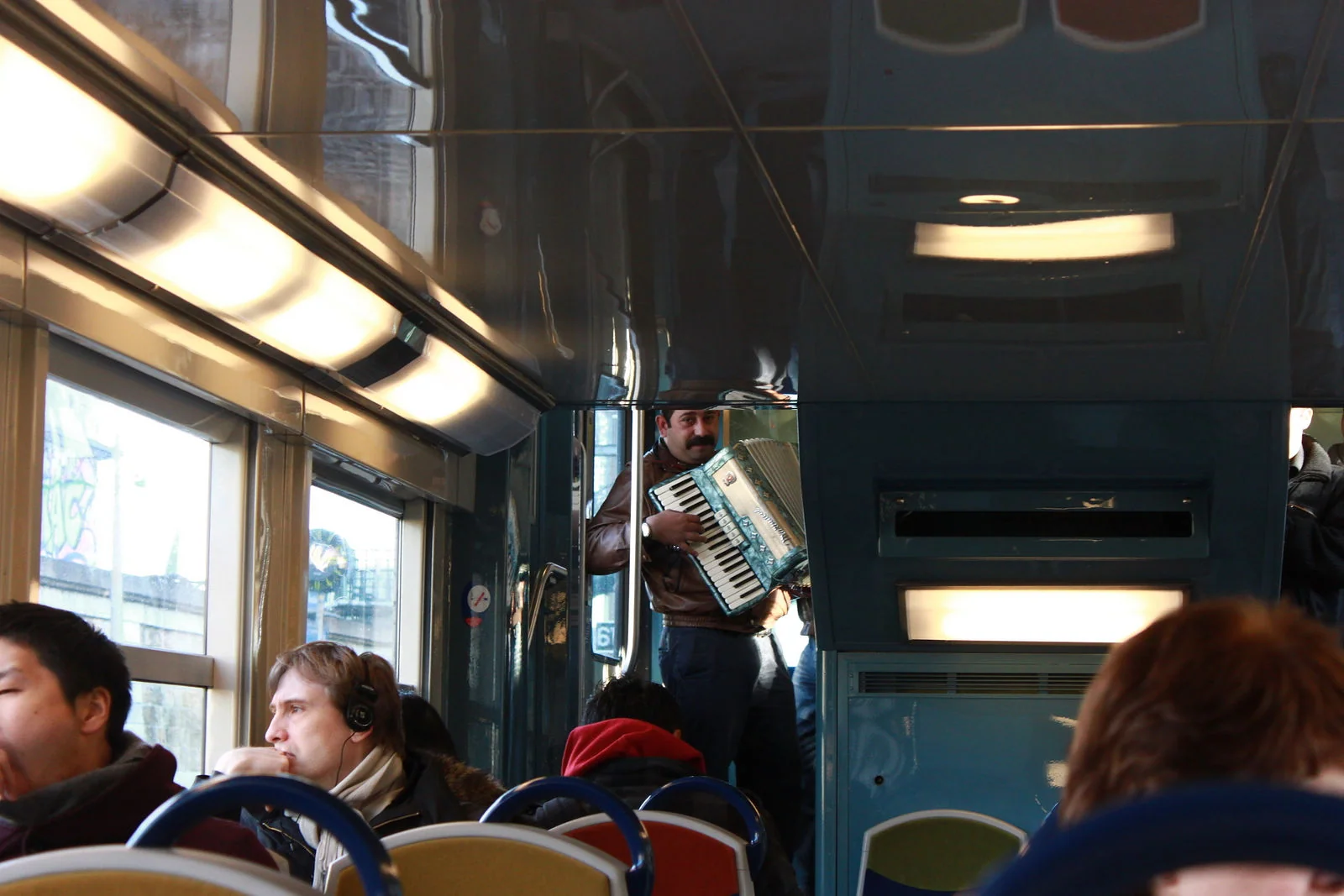
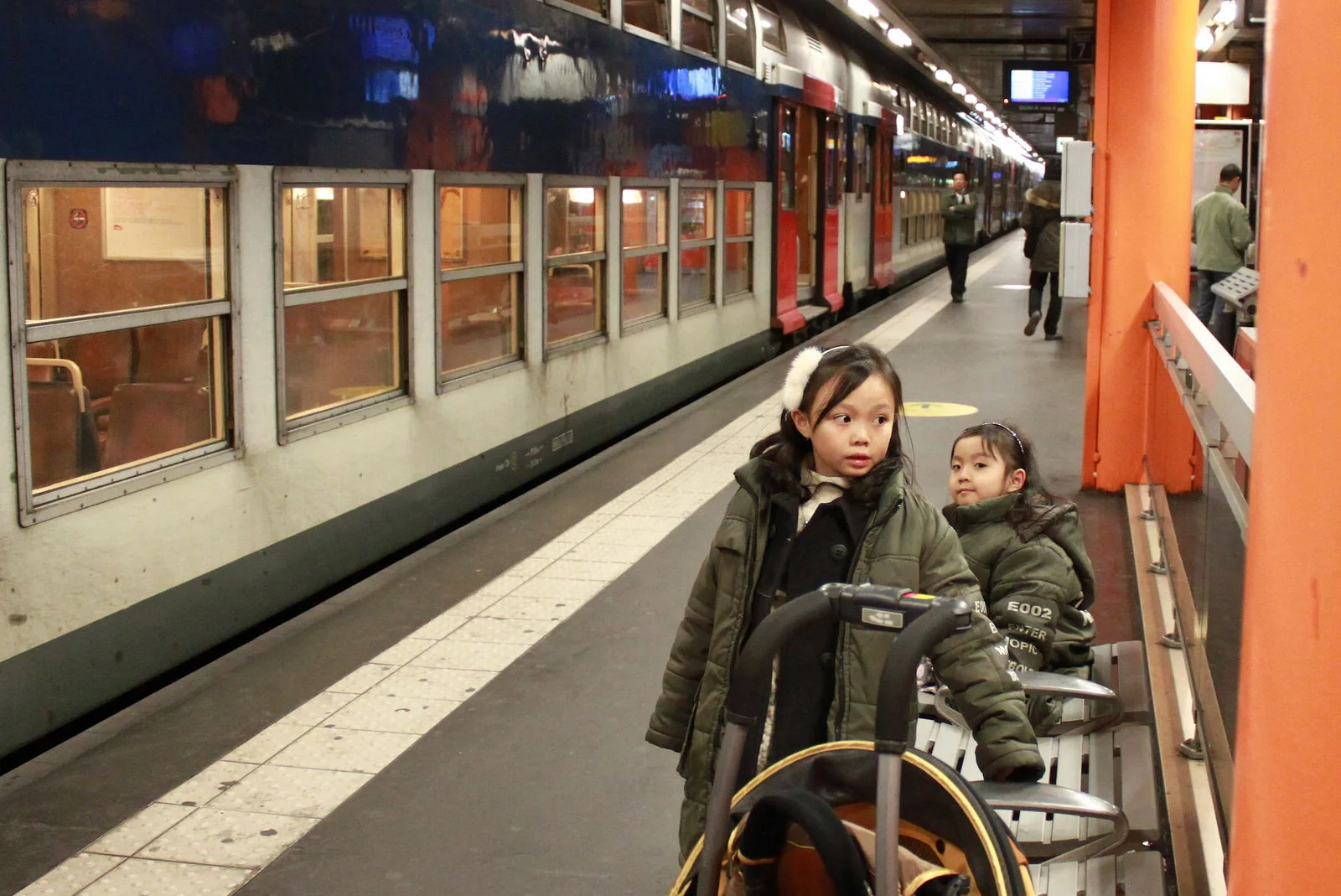
The ride was not long, roughly a little over half an hour. At first the girls sat nicely and looked out the window...

Before long, they started playing in the empty seats ~.~'"
Luckily, we arrived soon and did not disturb anyone too much.
After leaving the station, following the signs for about five minutes brought us close to the Palace. On the way, we saw a very beautiful building. I first wondered if it had once been the mansion of some royal minister.
After checking later at home, it seemed to be the Versailles City Hall, Mairie de Versailles, or some similar government office ~.~
After turning left with the crowd, we arrived on the broad avenue leading to the Palace. That walk has its own sense of ceremony: the gate, gold details, courtyard, and crowds are all ahead, and you can feel that you are approaching a former center of power.
In front of the square stood the bronze statue of King Louis XIV.
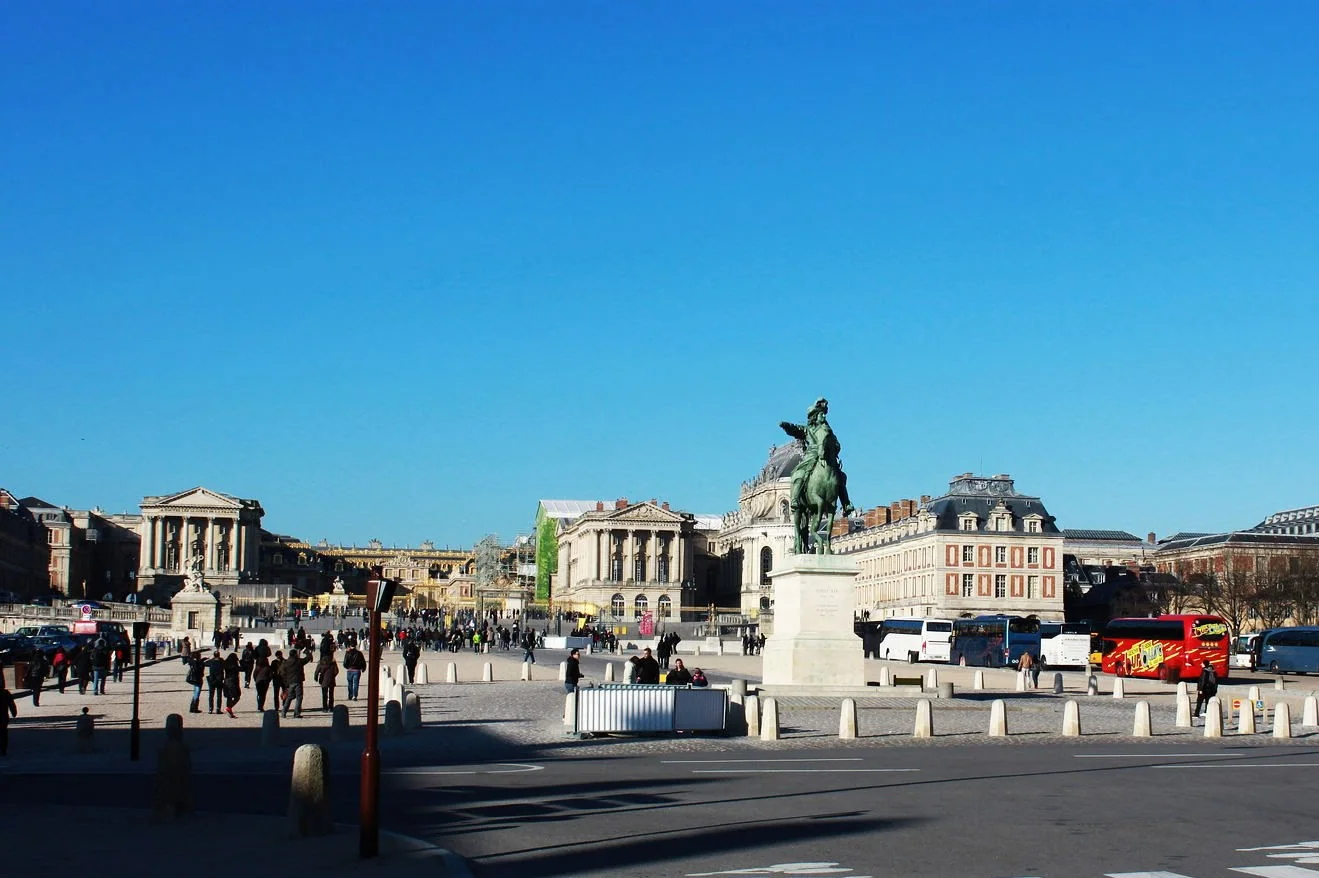
The sunlight was so bright that Lisa could barely open her eyes ~.~
This was the outer gate of the Palace of Versailles.
Inside the courtyard, the long line was for security before entering the Palace.
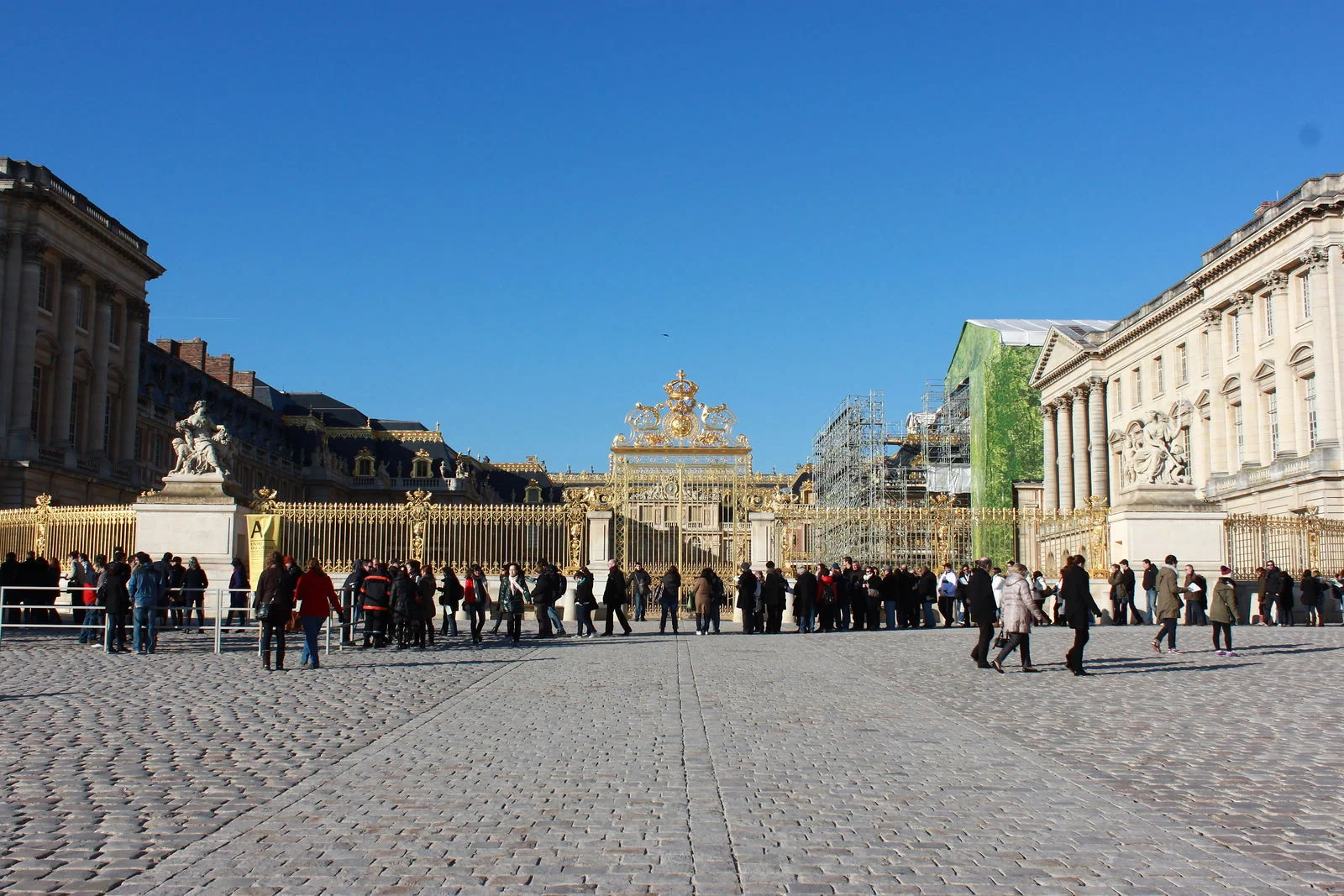
Everywhere you looked, there were elaborate carvings. We were lucky and waited only about 20 minutes before entering.
I heard that during peak travel season, waiting one or two hours for tickets and security is very common ~.~
The area where Versailles stands was originally forest and marshland.
In 1624, King Louis XIII of France bought 117 arpents of land and built a two-story red-brick hunting lodge here.
At that time, the lodge had 26 rooms. The second floor included the king's office, bedroom, reception room, wardrobe room, and rooms for attendants, while the ground floor was used for furniture storage and the armoury.
In 1660, King Louis XIV visited the estate of his finance minister Fouquet, Chateau Vaux-le-Vicomte, and was impressed by the grandeur of its house and gardens.
At the time, none of the royal residences outside Paris could compare with it. Angry with Fouquet for failing in his duties, Louis XIV had him imprisoned in the Bastille for corruption, then ordered Vaux-le-Vicomte's designer Andre Le Notre and the architect Louis Le Vau to design a new royal residence for him.
Because Paris had seen repeated unrest in the 16th and 17th centuries, including two major Fronde uprisings from 1648 to 1653, Louis XIV decided to move the royal court away from noisy, unstable Paris.
After consideration, he chose to build the new palace around Louis XIII's hunting lodge at Versailles, acquiring 6.7 square kilometers of land for the project.
Le Notre designed the gardens and fountains in 1667, while Le Vau added new wings to the west, north, and south of the hunting lodge, enclosing the original building.
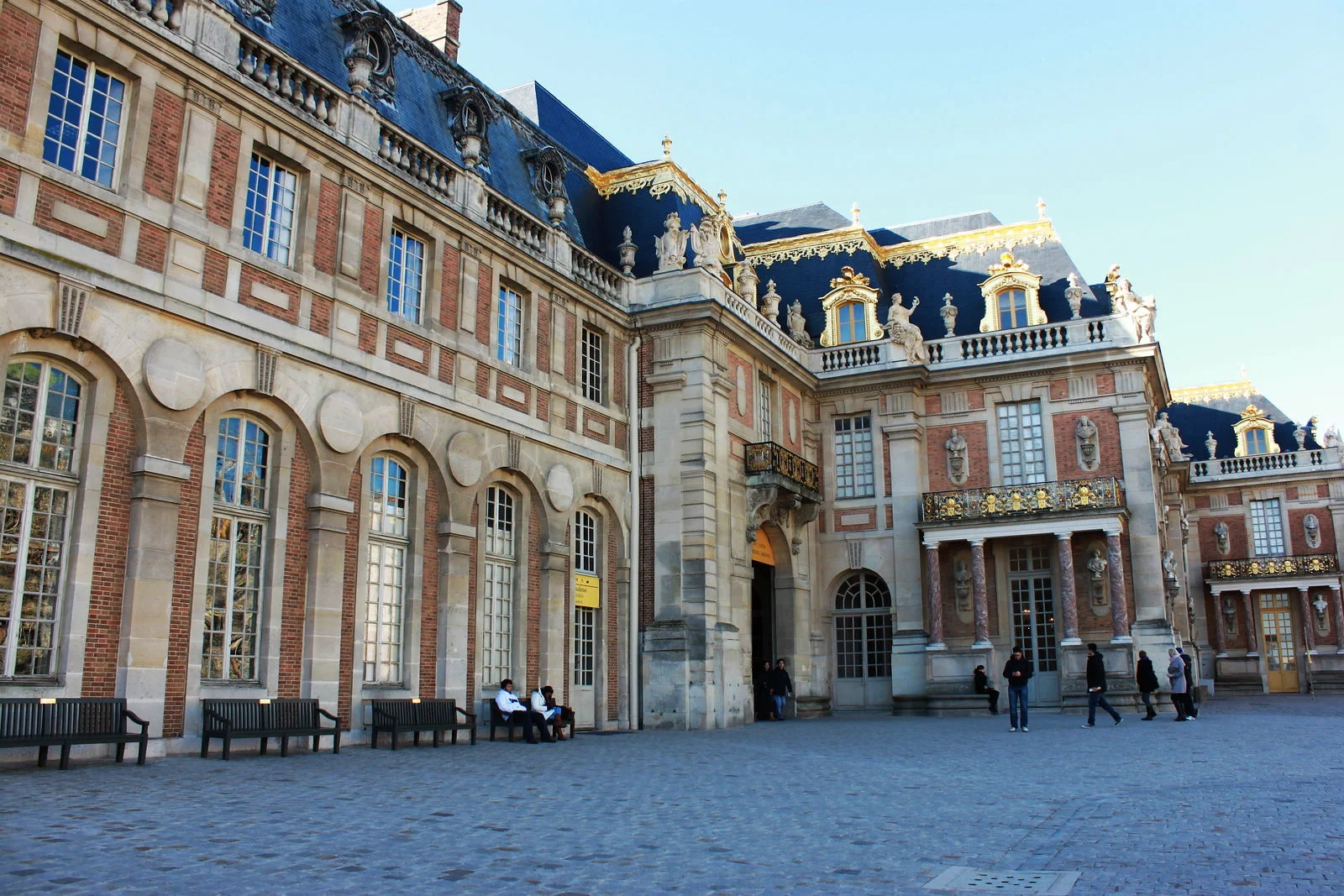
The eastern facade of the old lodge was preserved as the main entrance, and the Marble Court was built there.
In the Marble Court, the red-brick two-story building in front is Louis XIII's former hunting lodge. (Source from the original post: Wikipedia)
To attract residents to settle in Versailles, Louis XIV built many houses and offices in the town.
To ensure construction of Versailles could proceed smoothly, Louis XIV also ordered that, for ten years, no other new buildings in France could use stone.
To reduce the danger of powerful regional nobles creating separatist power bases or rebellions, after Versailles was completed, the major nobles of France were gathered there to live.
From 1682 to 1789, France's political and diplomatic decisions were made at Versailles, making it the de facto capital of France.
AI-added context: The official Versailles page on "Versailles, capital of the kingdom, 1682" says Versailles became the headquarters of government on 6 May 1682. Paris remained the official capital, but Versailles became the de facto center of the kingdom until 1789. (Château de Versailles official history page)
The main sights of Versailles are concentrated on the palace's first floor and in the gardens. At the entrance, you could borrow an audio guide. Thanks to the rise of Chinese tourism, many places now have Chinese introductions and Chinese audio guides ^.^
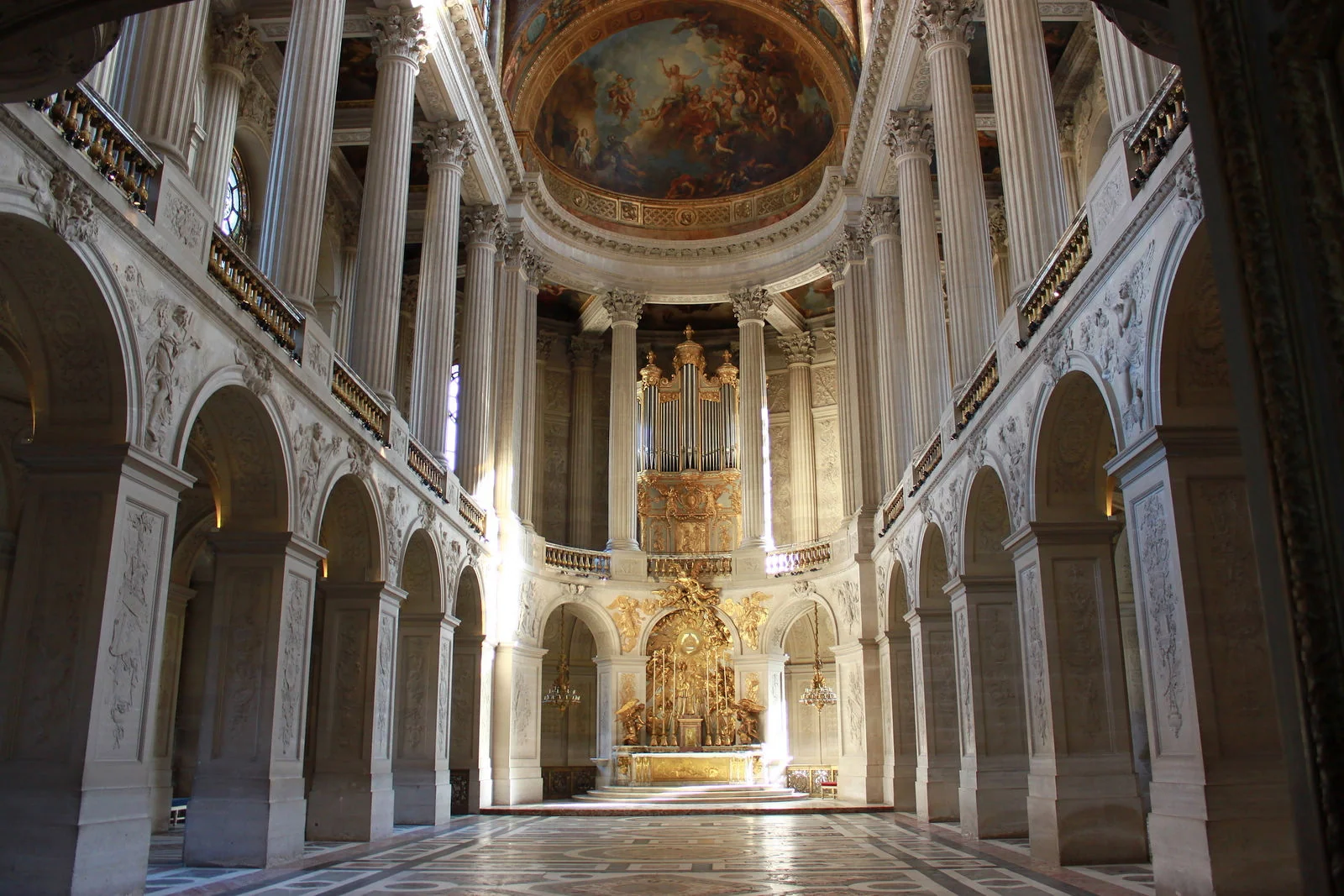
The first thing we saw after entering was the Royal Chapel.
We passed through the corridor, went upstairs, and arrived at the Hercules Room, Salon d'Hercule.
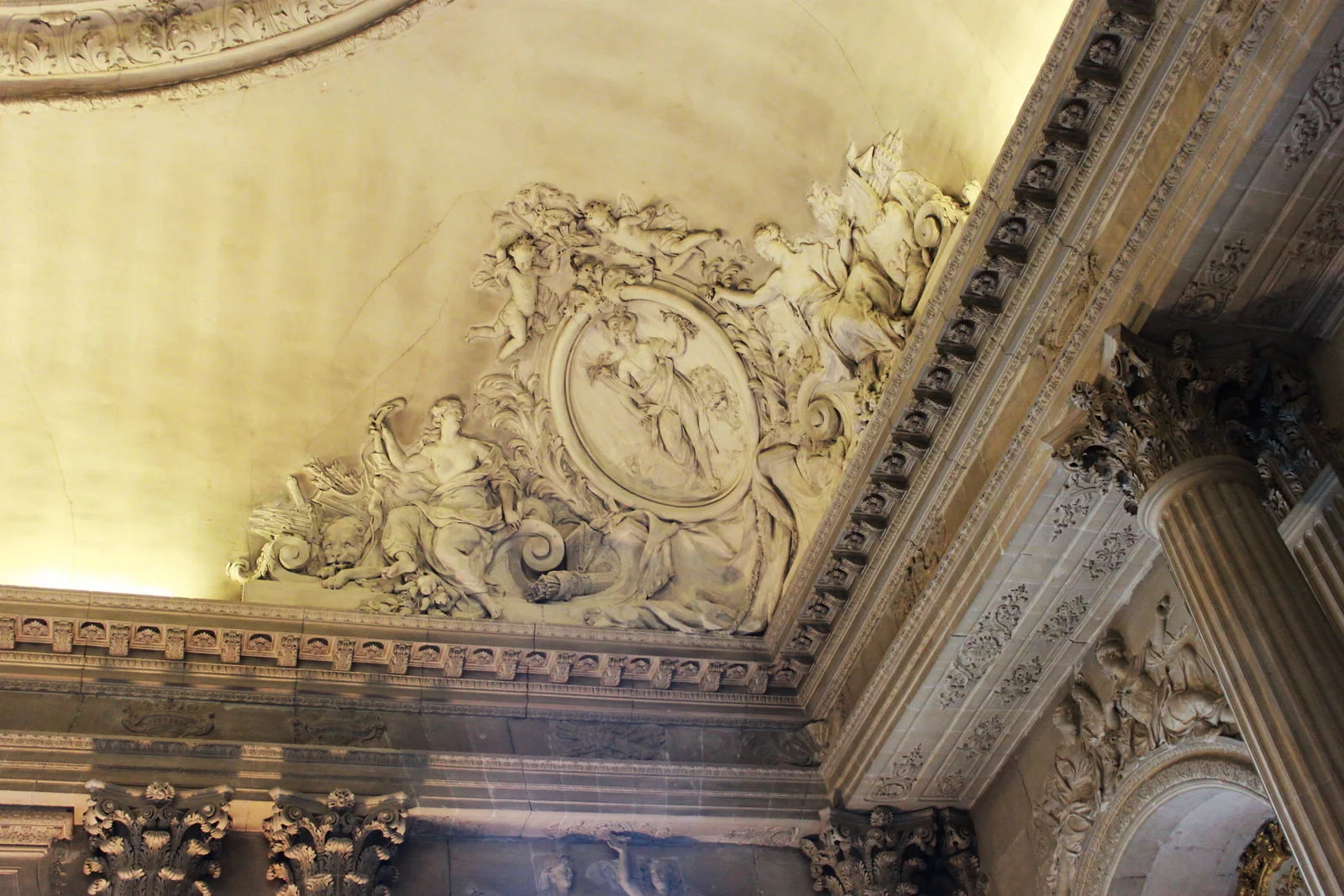
The Hercules Room sits at the northeast corner of the main building's first floor, connecting the central palace, the north wing, and the Royal Chapel.
During Louis XIV's time, this area was the royal chapel, and later it became a reception room for the king. From here onward, the rooms came one after another, full of reliefs, oil paintings, wall carvings, and other detailed works of art.
AI-added context: The official introduction to the King's State Apartment says the Hercules Room was the last room completed by Louis XIV near the end of his reign. From 1682, the space was occupied by a two-story palace chapel until the current Royal Chapel replaced it in 1710. (Château de Versailles - The King's State Apartment)
The Apollo Room, also known as the Sun Room, was the throne room of the French king.
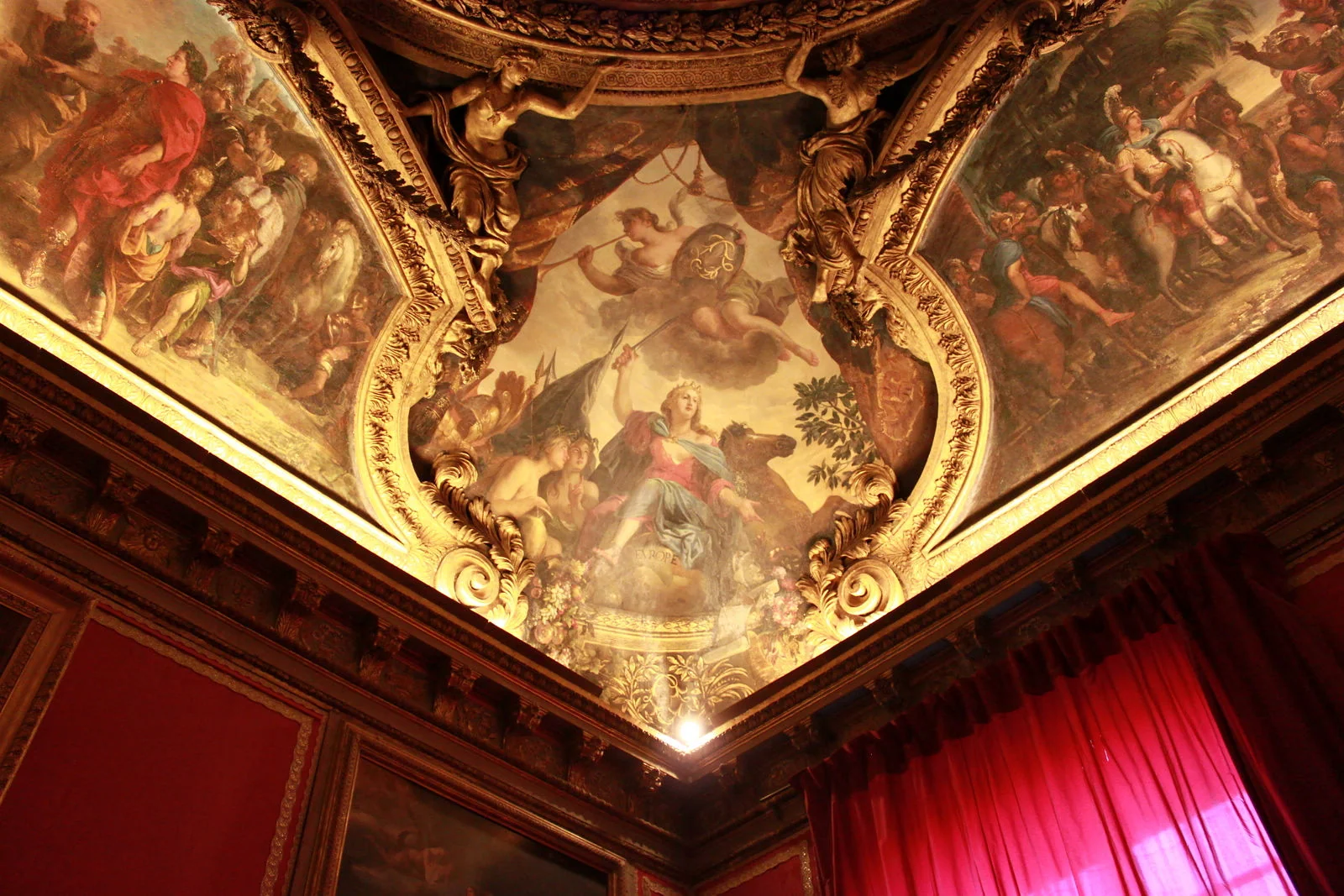
It was extremely luxurious, with gilded low-relief decoration on the ceiling, walls covered in deep red velvet edged with gold and silver thread, and a pure silver throne 2.6 meters high set on a platform covered with a dark red Persian carpet.
Because Louis XIV styled himself as the Sun King, the major rooms of Versailles were named after planets orbiting the sun.
The War Room, Salon de la Guerre.
Above the gilded fireplace was an equestrian relief of Louis XIV. This room led south into the Hall of Mirrors, and ministers would wait here before being received by the king.
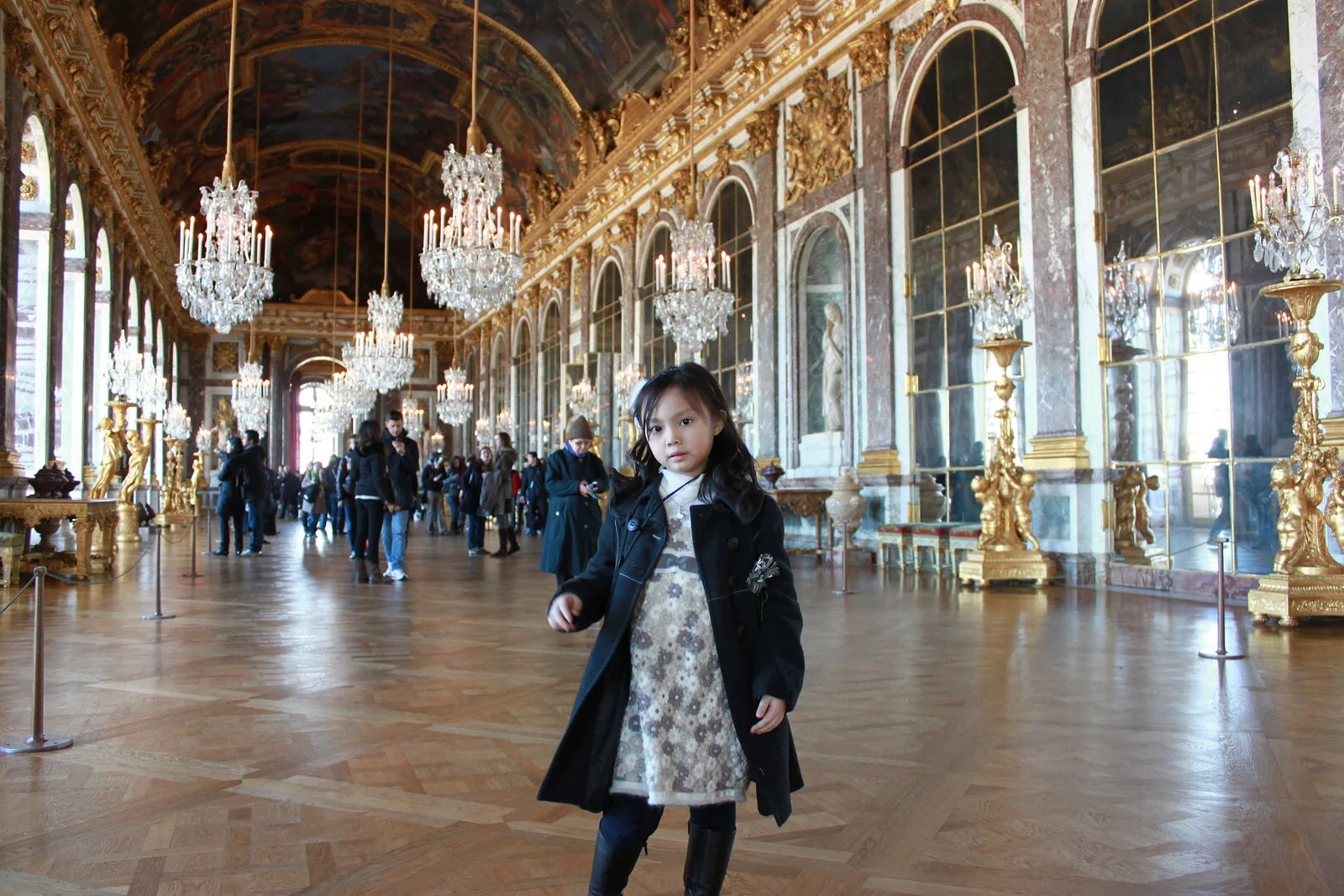
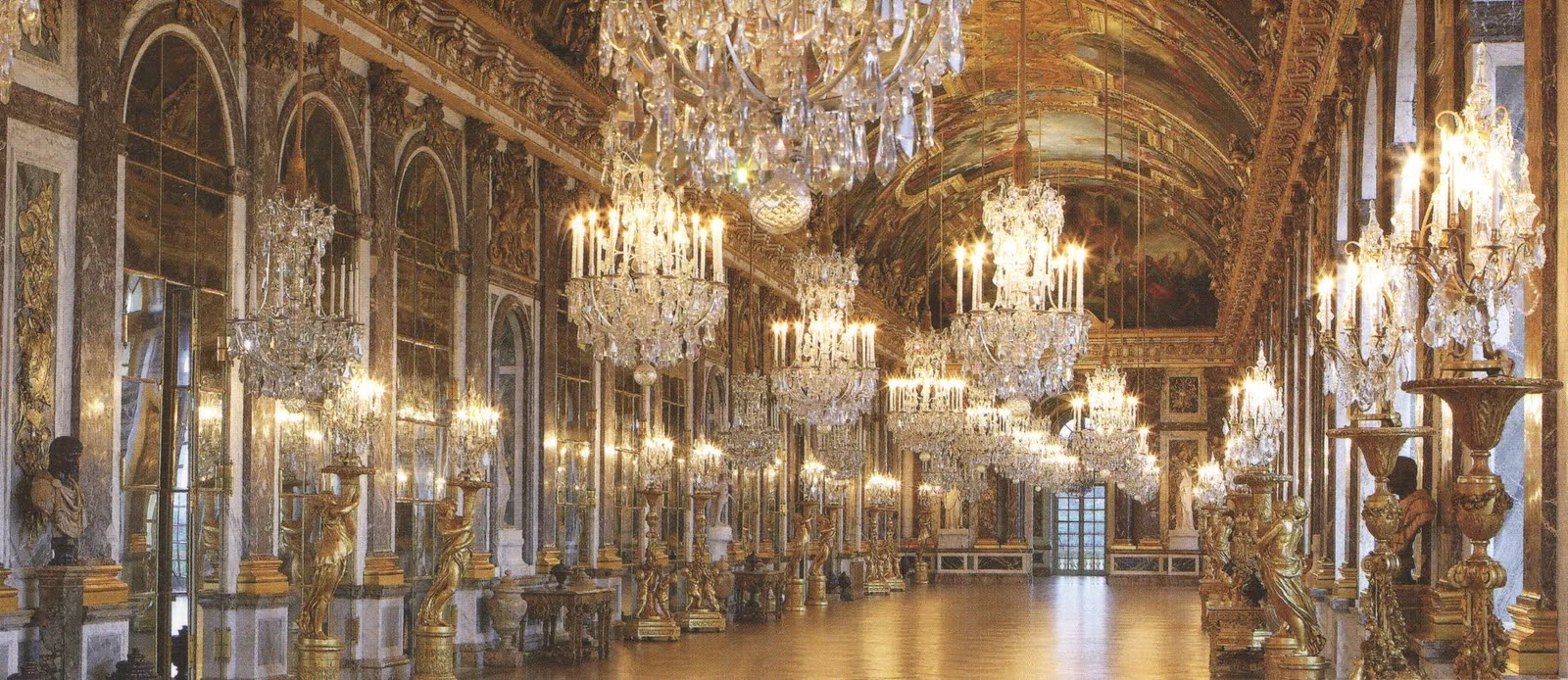
Then we entered the most famous room at Versailles: the Hall of Mirrors.
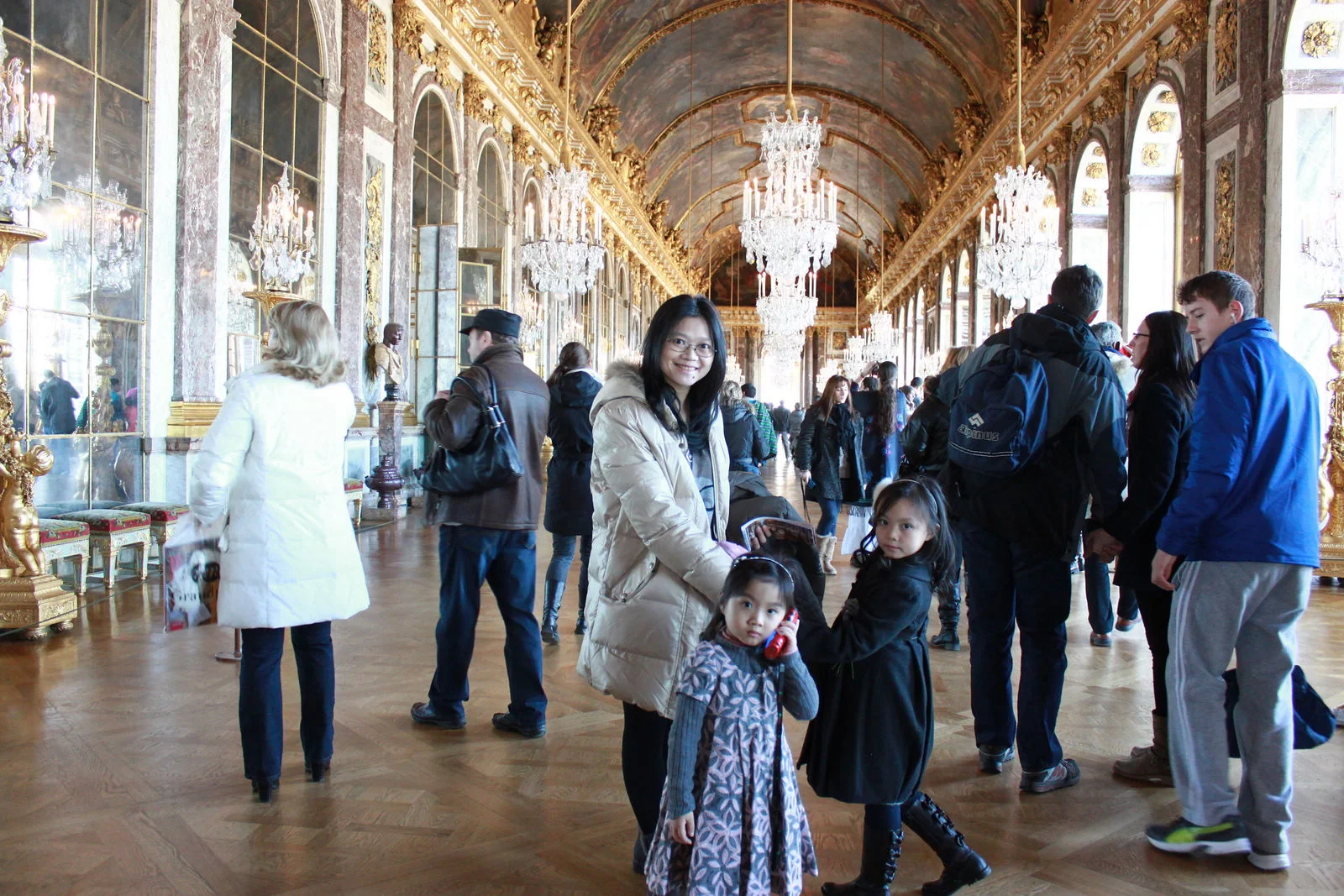
The Hall of Mirrors, Galerie des glaces, lies south of the War Room and faces the gardens to the west. It is the most famous hall in the Palace and was created by enclosing an open terrace.
It is 76 meters long, 13 meters high, and 10.5 meters wide. One side has 17 huge floor-to-ceiling windows facing the gardens, while the other side is covered with a vast mirrored surface made from more than 400 mirrors.
The floor is decorated with fine woodwork, the walls are faced with pale violet and white marble, and the columns are green marble. The capitals, bases, and wall panels are gilded brass.
The decorative motif is a winged sun, a symbol of reverence for Louis XIV. The ceiling carries 24 large Bohemian crystal chandeliers and paintings celebrating the Sun King's achievements.
In Louis XIV's time, the furniture and potted plants in the Hall of Mirrors were also made of pure silver, and grand masquerade balls were often held here.
AI-added context: The official Versailles page gives the Hall of Mirrors as 73 meters long and says it contains 357 mirrors. It is also the place where the Treaty of Versailles was signed in 1919. I am keeping the numbers from the original travel research above and listing the official figures here for comparison. (Château de Versailles - The Hall of Mirrors)
Looking out the windows, you could see the Gardens of Versailles.
In the middle of the Hall of Mirrors, two doors lead into the king's bedchamber.
Before entering the bedchamber, there is another room called the Bull's Eye Room, named after the bull's-eye-shaped window above the door to the king's bedroom. It was a waiting room for princes, nobles, and ministers.
According to the audio guide, court ministers had to wait here every morning and evening for the king to wake up and go to bed...
Higher-ranking people attended the king's rising and retiring ceremonies here, while lower-ranking ones went to attend princes and other royals @.@'"
Next, we entered the King's Bedchamber.
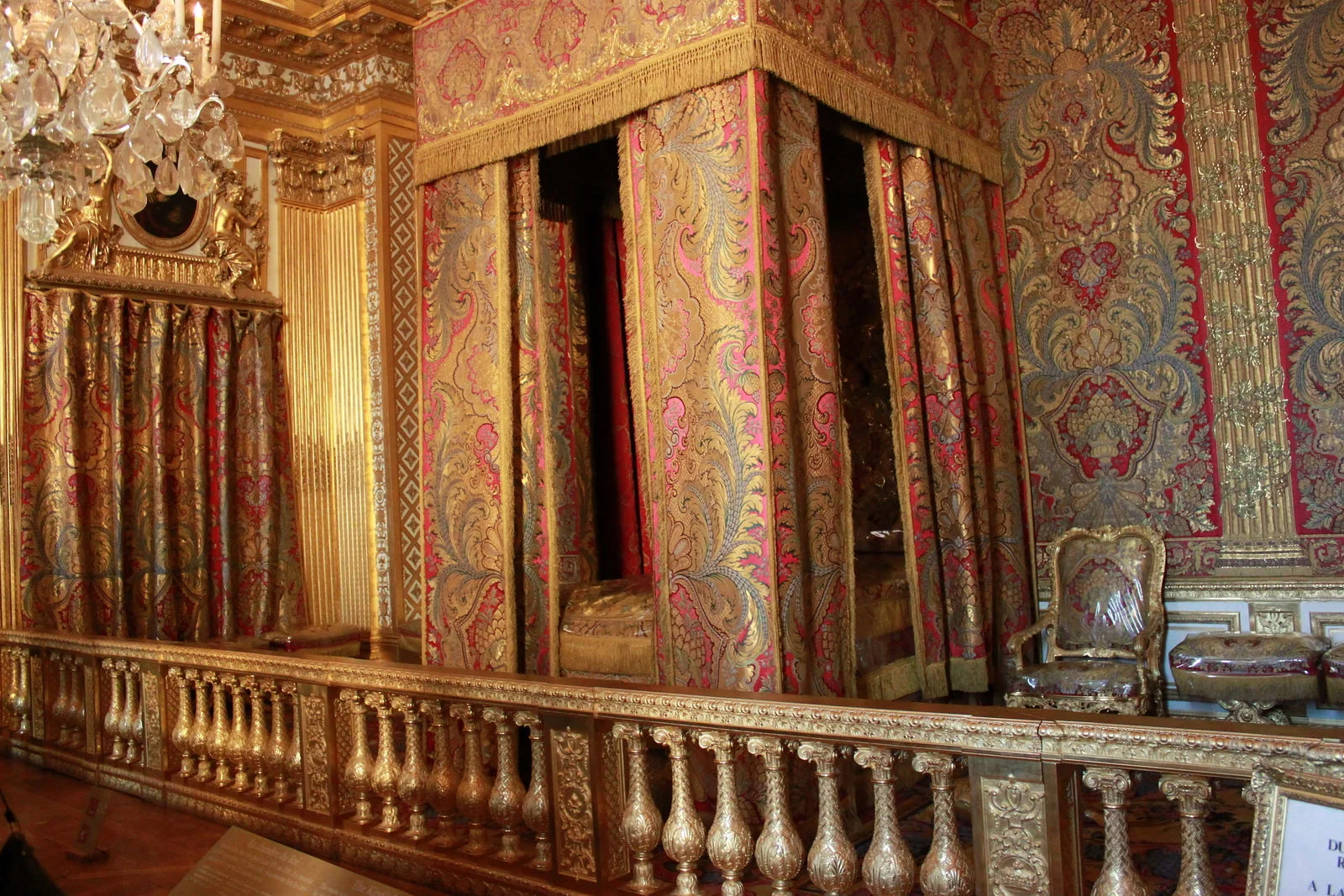
The King's Bedchamber is on the east side of the main building, inside Louis XIII's old hunting lodge.
At the center is the king's bedchamber, with a red-and-gold brocade bed, embroidered canopy, gilded railings, and a large ceiling relief titled France Watching over the King's Sleep.
This was the political center of the Palace, where the lever, morning audiences, evening audiences, and bedtime ceremonies took place. Turning "waking up" and "going to sleep" into state rituals is the kind of thing only the age of absolute monarchy could come up with.
After that came the room where the king ate breakfast, and the place where he discussed state affairs with ministers.
After making a loop, we came back to the Hall of Mirrors again ^.^
When you visit Versailles, it is hard not to be overwhelmed by the scale of the Hall of Mirrors!!
But with people constantly moving through it, I really could not capture the feeling in a photo. I photographed one image from the guide booklet instead, to see whether it could show some of that visual impact ~~
Leaving the Hall of Mirrors, we came to the other side of the main building: the Queen's Apartments.
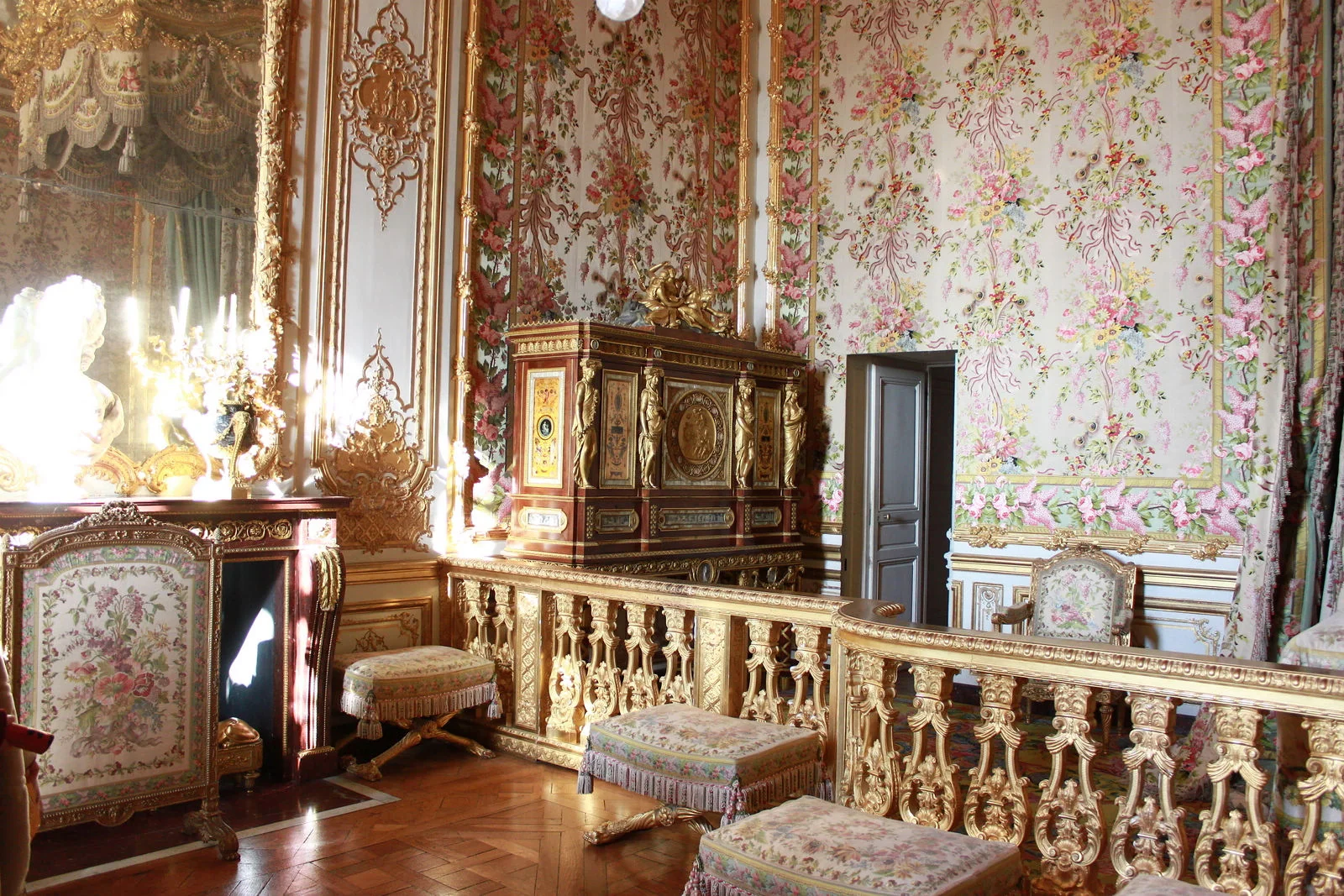
The Queen's Apartments are on the south side of the main building and include the queen's bedchamber, private rooms, waiting room, ladies' withdrawing room, guard room, and other rooms.
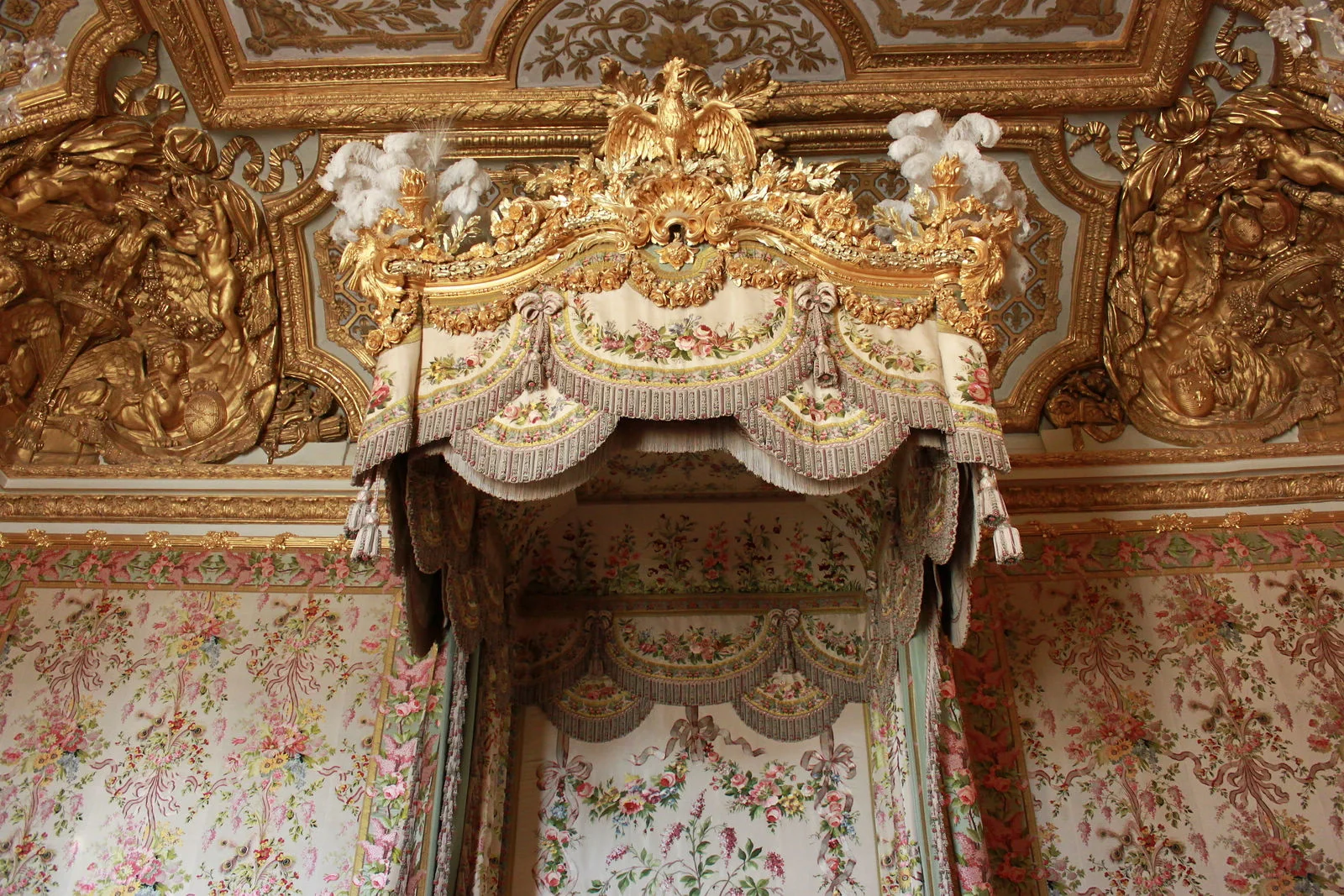
Next to the bed is a small door that was originally hidden behind a cabinet.
During the French Revolution, Marie Antoinette, queen of Louis XVI, escaped from Versailles through that door ~.~'"
When writing this travelogue, I found an interesting article about Queen Marie Antoinette online. If you are interested in French history, you can read it too: 瑪莉皇后
Look at how focused Lisa was while listening ~~
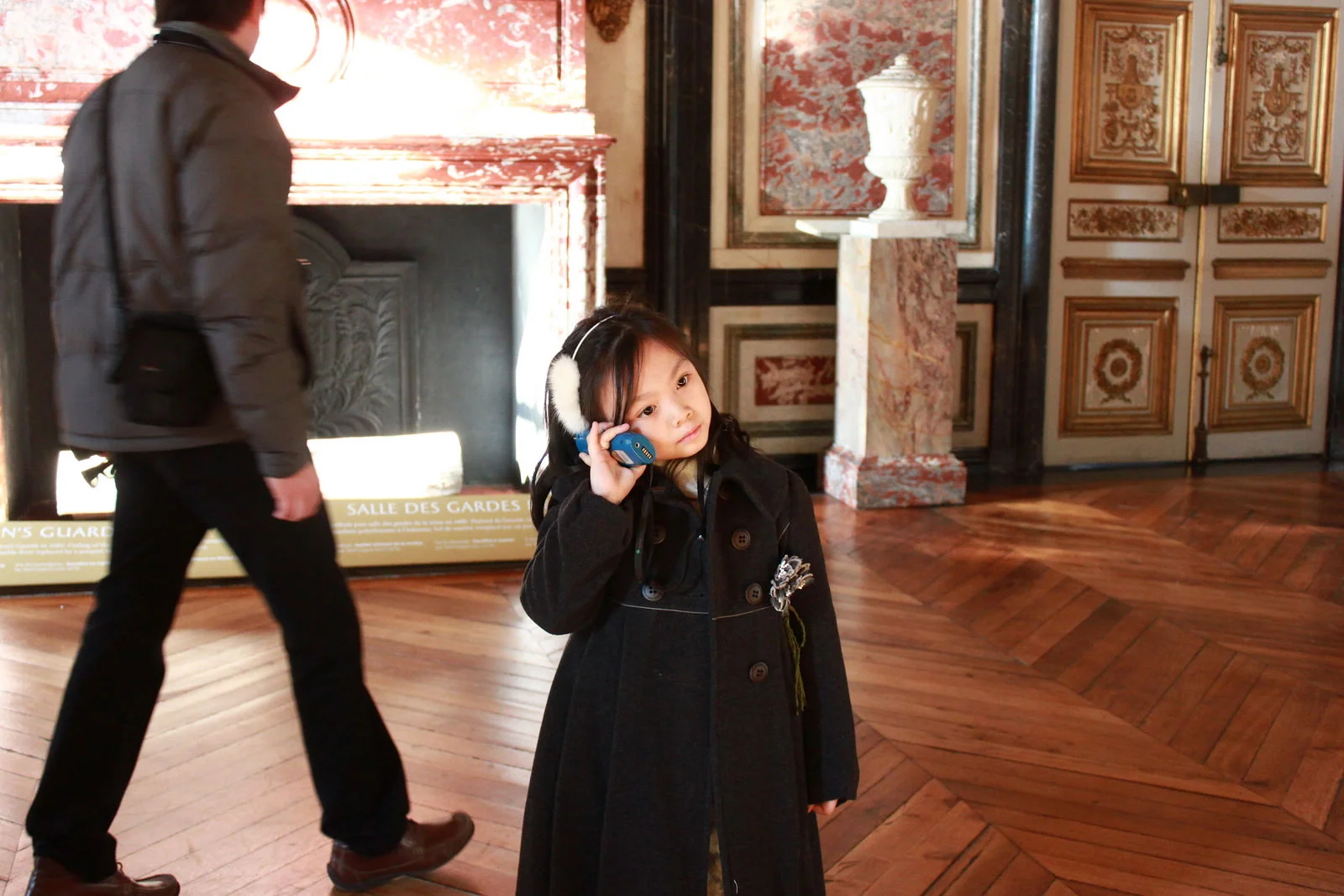
After going downstairs, we reached the princes' residence area, but that part was not open to visitors.
Following the audio guide through the Palace took roughly two hours, and by then we were hungry.
Near the exit from the main building into the garden, there was a cafeteria where we could get sandwiches, bread, coffee, hot chocolate, and other simple food for lunch.
Hey... lunch inside a palace ^.^
Let's go. Time to walk around the gardens ^.^
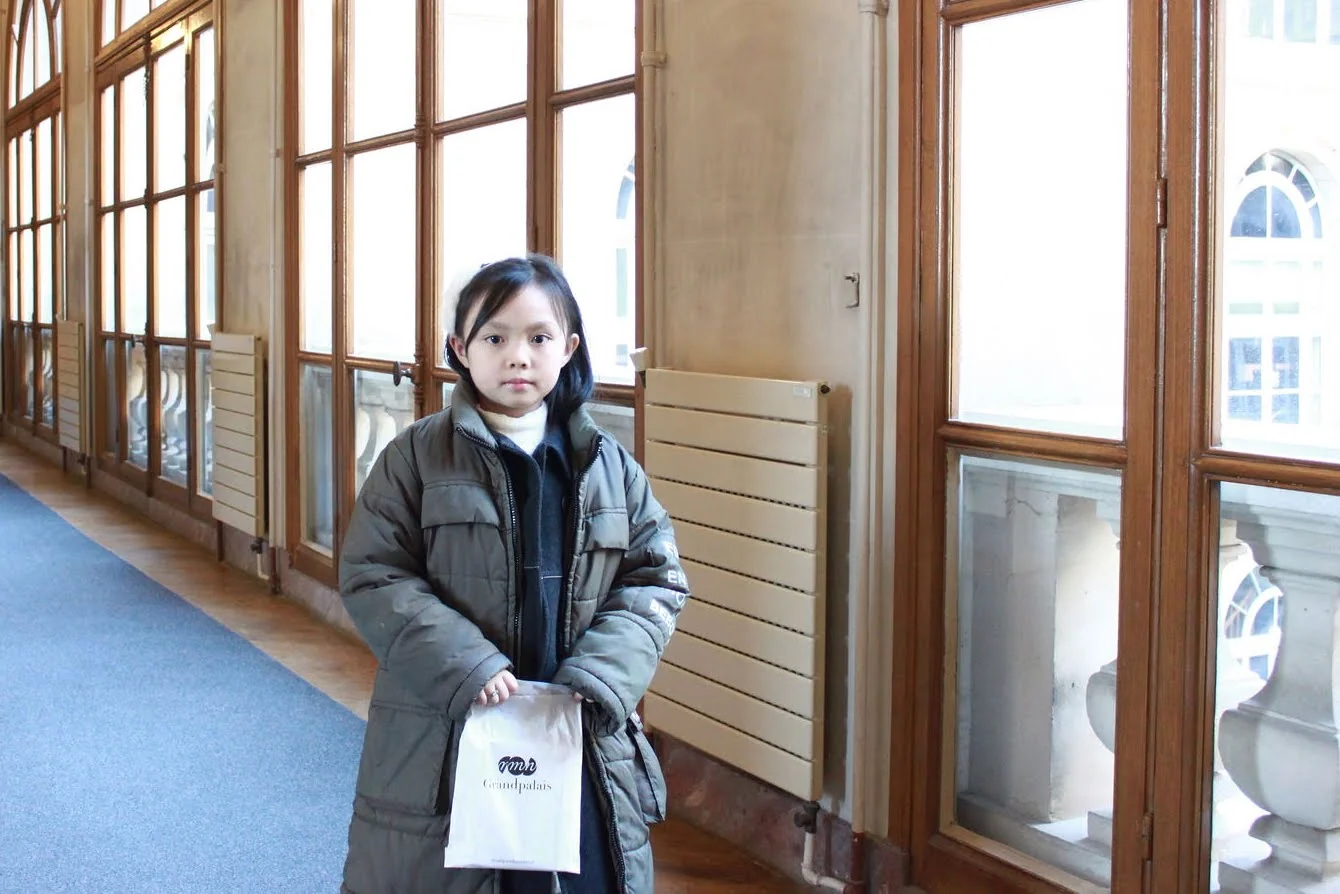
Since this post already has too many photos, I decided to write the garden part separately as "Gardens of Versailles." Otherwise, just loading the photos would take forever @.@'"
2012 Let's Go to Paris
Part 1 Planning the Trip
Part 2 Departure and Arrival
Part 3 Cruising the Seine
Part 4 The Palace of Versailles
Part 5 Gardens of Versailles
Part 6 Disneyland Paris
Part 7 Rue Mouffetard Market, Notre-Dame, Musee d'Orsay, and Galeries Lafayette
Part 8 Chateau de Fontainebleau
Part 9 Champs-Elysees and Arc de Triomphe
Part 10 French Food
Complete Photo Gallery
Previewing up to 8 album photos. Open the gallery to browse all photos.